
How do you keep track of everything that goes on in a debate round? It can become hard at times to keep up during dense debates about a specific type of philosophy or policy, let alone multiple of these contentions. Think about taking notes in class, and how it serves to help you remember key concepts and actively pay attention. The same idea applies to debate, where a debater always takes notes on what happens in the round, as well as their responses to their opponent. This note-taking in debate is called flowing, which is the key idea of this lesson. Keeping track of what your opponent says while planning what you want to say next is important. Flowing ensures that you aren’t dropping any arguments and are thoroughly covering everything in the debate with well-thought responses.
Explanation: Step-by-Step Flowing
Though there are many different ways to flow, we’ll be covering one effective and popular method: flowing in vertical columns. You will need 2 blank sheets of paper. Orient them either vertically or horizontally (depending on whether you want longer or wider sections of the paper to write on). Personally, I usually flow portrait mode (vertically-oriented paper), because narrow yet long columns give more space to write short jot notes and responses.
Using your 2 sheets, you will be writing on one side of the paper for both. Do not try to save an extra bit of paper and double-side your paper. Aside from hindering your overall ability to debate well, this will be very painful to deal with when flipping the sheet over and over again.
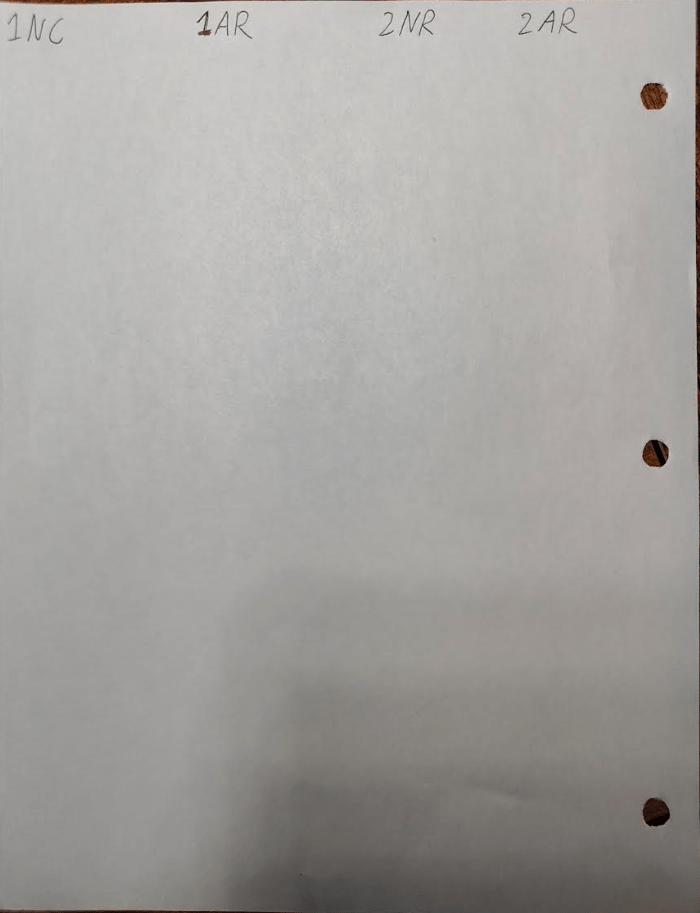
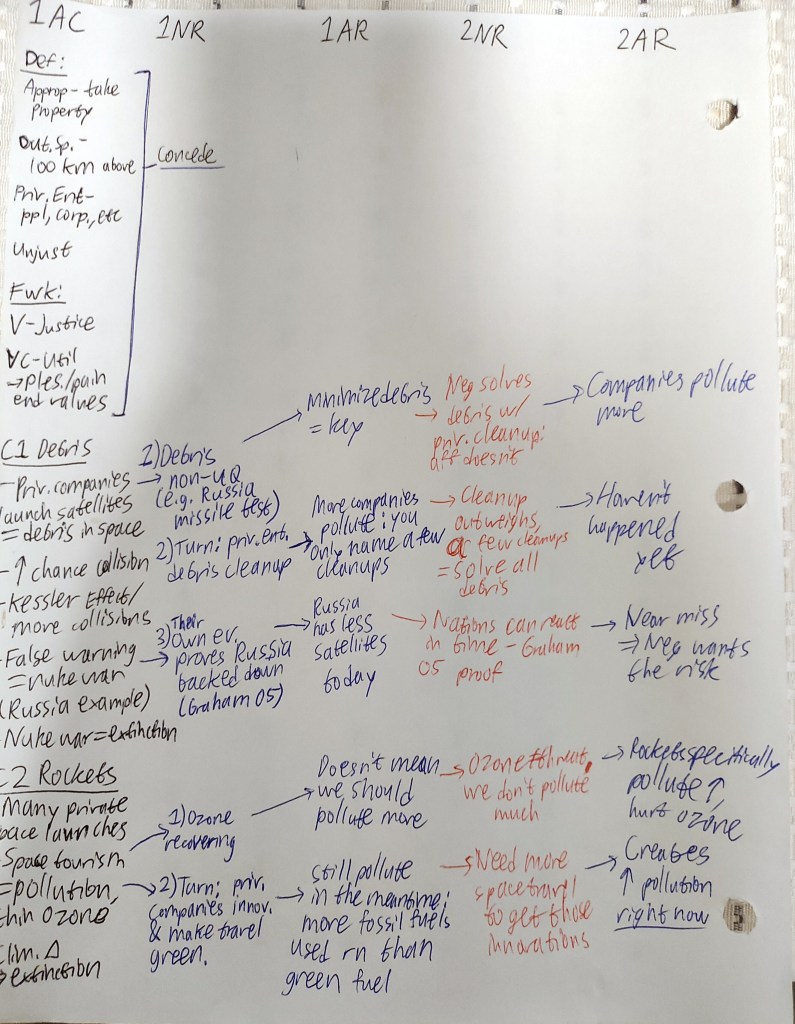
One sheet of paper will be evenly divided into 5 columns (1AC, 1NR, 1AR, 2NR, & 2AR). The second sheet will be divided into 4 columns (1NC, 1AR, 2NR, & 2AR). These are shown in the images below.
Notice that the first sheet has the 1NR (and 1AC) instead of the 1NC. The 1NR column is for responses to the 1AC (Aff’s contentions), while the 1NC is for taking notes on the Negative’s contentions.

If you’re using paper with binder holes in them, make sure to put the holes to your right so that you have room to flow the 1AC.
Now you’re all set to start flowing!
Using the example space topic cases from a previous lesson on Building a Case, we will be going through how both the Aff and Neg would flow this round. Cases are re-attached below:
Aff 1AC
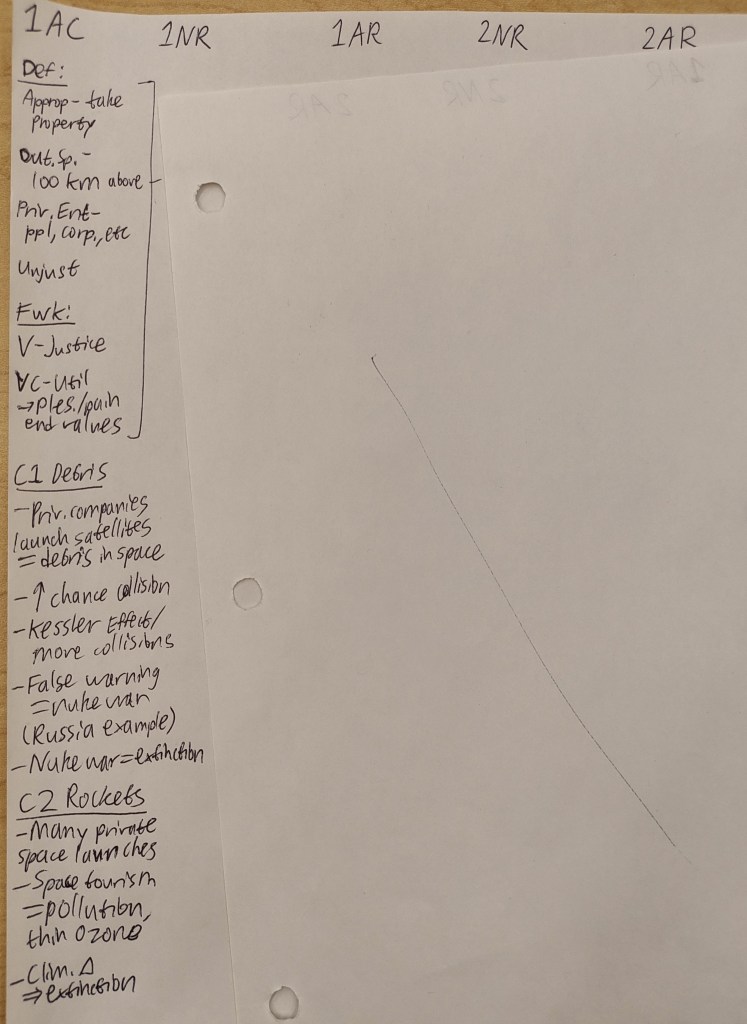
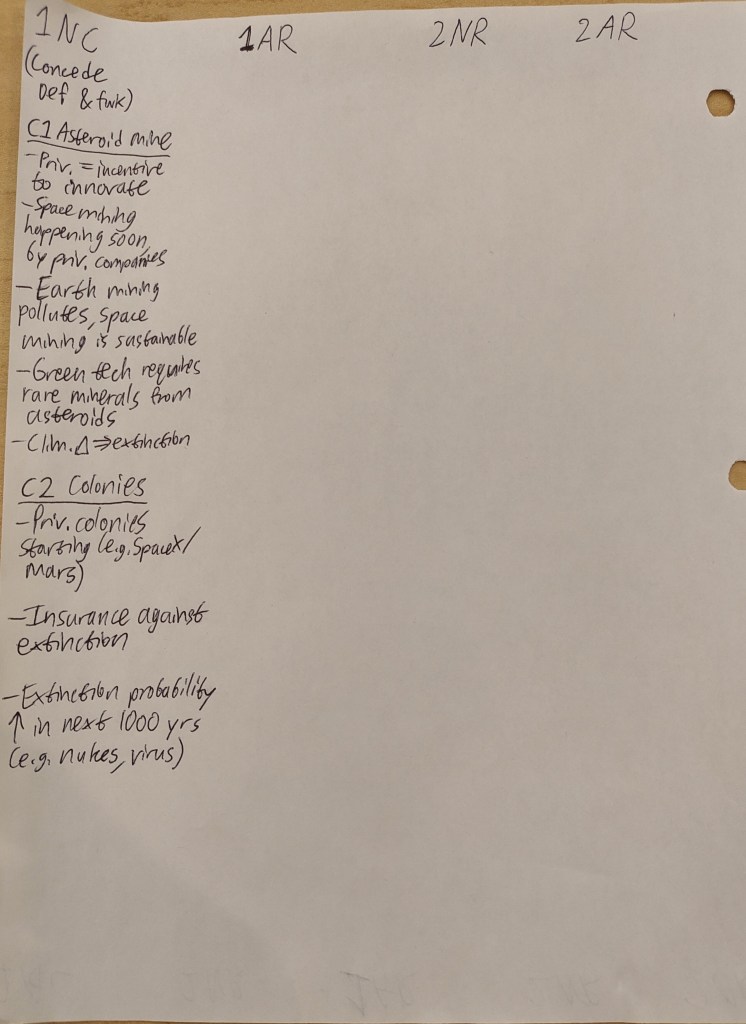
Firstly, the Aff would present their constructive speech. Both Aff and Neg debaters would flow the 1AC’s key points: including definitions, value & value criterion, and contentions. Be sure to keep track of important numbers and/or statistics, but not necessarily every single one of them.
The Neg would take these notes while the Aff is giving the 1AC speech. But the Aff debater can’t take notes at the same time as they’re speaking, so this is where preflowing comes in. Preflowing is exactly as it sounds: it’s basically flowing before you start your speech, hence flowing before the round starts. If you’re the Aff, flow your 1AC around five minutes before your round starts. Same for the Neg: flow your 1NC even before the Aff starts their speech (five minutes before round start), so that you don’t waste precious in-round prep time.
Cross-examination would then occur for 3 minutes, then prep time for the Neg.
Neg 1NC + 1NR
During the Aff’s 1AC and prep time, the Neg should be making responses in the 1NR section of the flow. This includes turns or takeouts to the Aff’s contentions, drawing arrows between individual links of the Aff to the Neg’s specific response. Afterwards, when the Neg debater stands up to give their 1NC and 1NR speech (the 7 min total), they would first open up their Word doc full of contentions, read for around 4 minutes, then move to their flow paper (1NR) to respond to the Aff for the rest of the time. Below is the 1NR, in blue ink. As well, flowing in different colors can sometimes be useful to help you easily distinguish your arguments from your opponent’s on your paper.
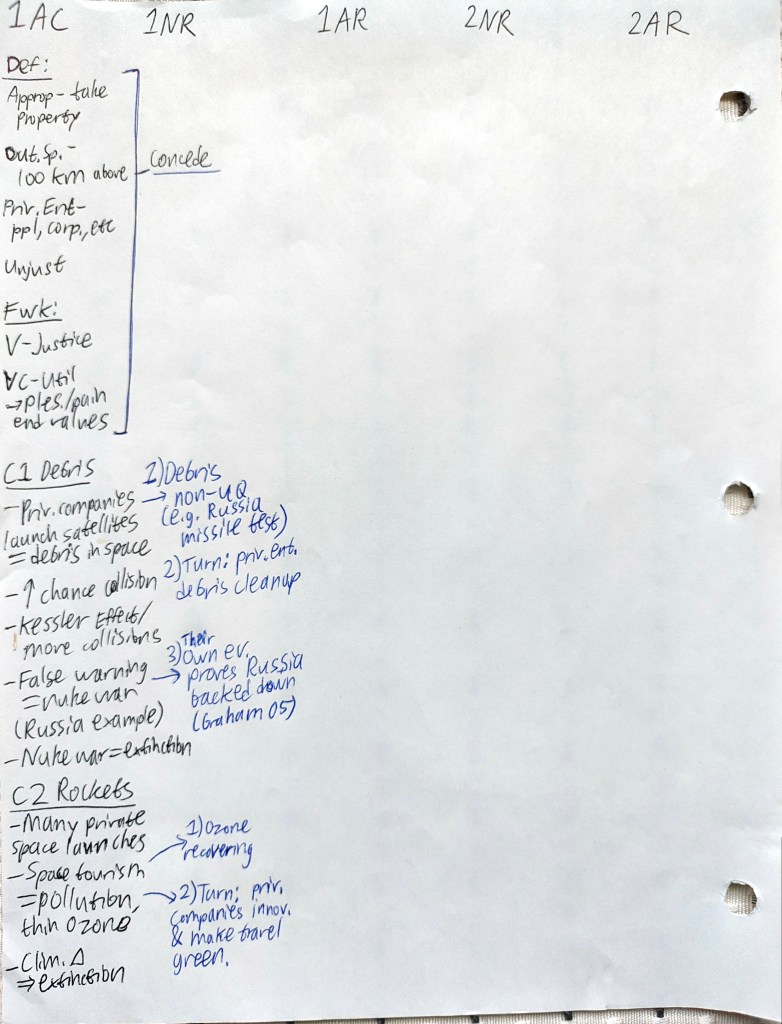
Notice that there are multiple responses on each Aff contention: make sure to put ample pressure on your opponent so that their next speech is hard. As well, most of the things you will be saying in your speeches will come from you yourself, rather than reading off of the sheet of paper word-for-word: the flow paper and your jot notes are just there to guide your speech and help you remember your points. Now, explaining the list of 1NR arguments,
Addressing Aff C1:
- Debris is non-unique. It will occur whether or not we decide to allow private companies into outer space, because public actors such as the governments of China and Russia are test-launching missiles into space and destroying their own satellites into a million pieces.
- Turn: private companies are key to debris cleanup in space, due to new innovations.
- The Aff’s own evidence (their Graham 05 card) proves that Russia is capable of backing down in the case of a false warning. Hence, no nuclear war.
Addressing Aff C2:
- The ozone layer is recovering. No extreme warming even if we launch a few rockets.
- Turn: private companies are innovating and helping make space travel environmentally sustainable through new rocket fuels.
These entire arguments are summed up in a few jot notes on the flow, hence showing the efficiency of flowing entire ideas and points at a time, rather than writing paragraphs upon paragraphs in the middle of the round.
But sometimes, purely analytical responses may seem dubious and suspicious, especially when referring to new innovations and developments that seem so futuristic and impossible. You want some sources to back that up. Recall the previous Rebuttals unit, which states that there are both analytical (purely speaking from reason, but no evidence) and carded (with sources) responses. Carded responses can sometimes come in handy, and if the Neg wanted to gain credibility in the eyes of the judge, their 1NR should probably include evidence to back up seemingly wild claims.
In this example of a 1NR, the Neg should pair their flow sheet with some prepared cards (prepared before the round started, based on what the Neg thought the Aff would read in the 1AC). All of their 1NR responses (in this specific example) should be carded, except for the 3rd response to debris, which refers to the Aff’s already existing evidence. Attached below is a possible set of cards the Neg could read immediately following their 1NC (in the 1NR), building off of their 1NR flow.
These carded, pre-written 1NR responses are called blocks. Blocks, or rebuttal blocks, are arguments that respond directly to specific contentions read by your opponent. Blocks are commonly read in rebuttals, in speeches where new evidence is usually accepted. But later on in the debate, in the 2NR or 2AR, try not to read new cards, since you are giving your opponent less time to respond to new evidence so judges often frown upon it.
Commonly in these block files, the terms “AT” and “A2” pop up. These are just abbreviations of “Answer To”, so if you see these in front of a phrase, it commonly means it is answering that contention. For example, “A2 Debris” in the Neg’s block file is the answer to the debris contention.
Aff 1AR
Back to the debate at hand: after the 1NR, cross-examination would go on for 3 minutes. Then the Aff would take prep, and could do the exact same thing that the Neg did by introducing blocks and responses to the 1NC and 1NR. The Aff would alternate between making analytical arguments while referring to cards in their file when needed.
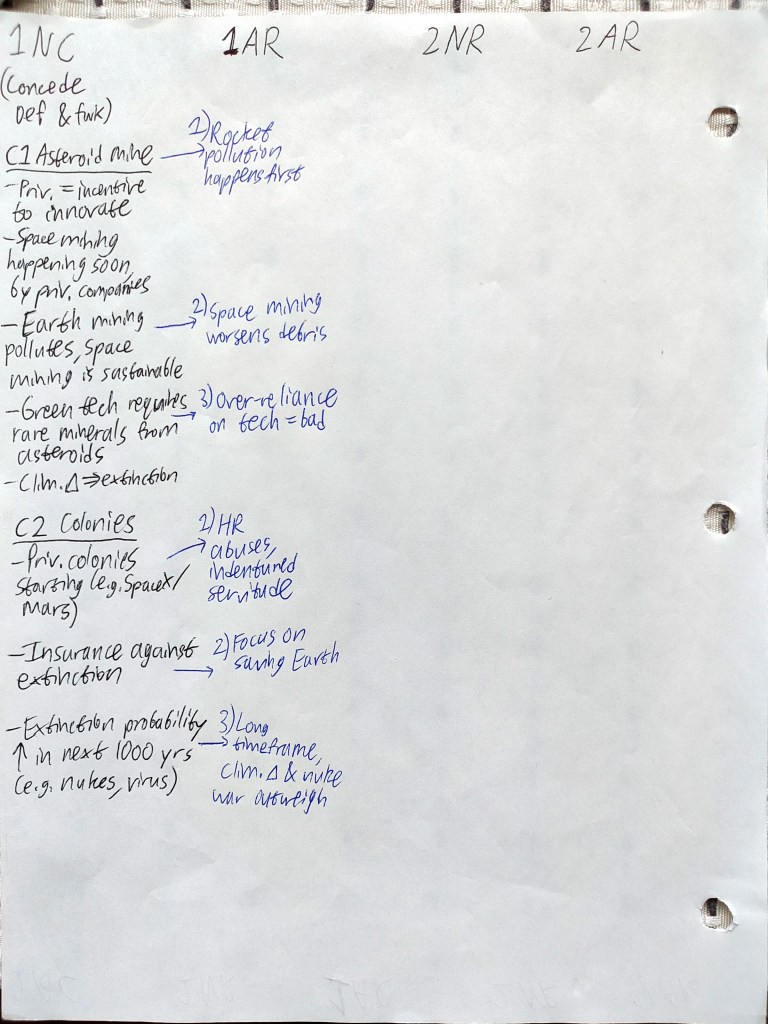
As a brief explanation of the 1AR against the Neg contentions,
Addressing Neg C1:
- Rockets pollute before we can get Neg’s green tech benefits, thus we must prioritize the Aff’s impact of stopping rocket pollution in solving better for climate change.
- Space mining causes space dust from asteroids, worsening the space debris problem for Earth (see card in 1AR blocks file).
- Over-reliance on tech to solve climate change is a dangerous mindset, allowing humans to pollute more (see card).
Addressing Neg C2:
- Indentured servitude will result from colonizing planets like Mars, due to billionaires prioritizing profits and not caring about the welfare of their workers (see card).
- Focusing on saving Earth first rather than abandoning it for other planets is a better mindset, in order to actually focus on the reality affecting us. We can’t take all 8 billion people on Earth to outer space, so the Neg will be sacrificing human lives by abandoning Earth.
- (impact weighing) Their extinction scenario takes such a long time to happen (1000 years) that it doesn’t matter in the scope of this debate. Prioritize solving climate change or preventing nuke war first, since they have both high probability AND short timeframe.
Be sure to also rebuild your own contentions, and go down the line by line of the Neg’s responses against your contentions (e.g. from the 1AC)!
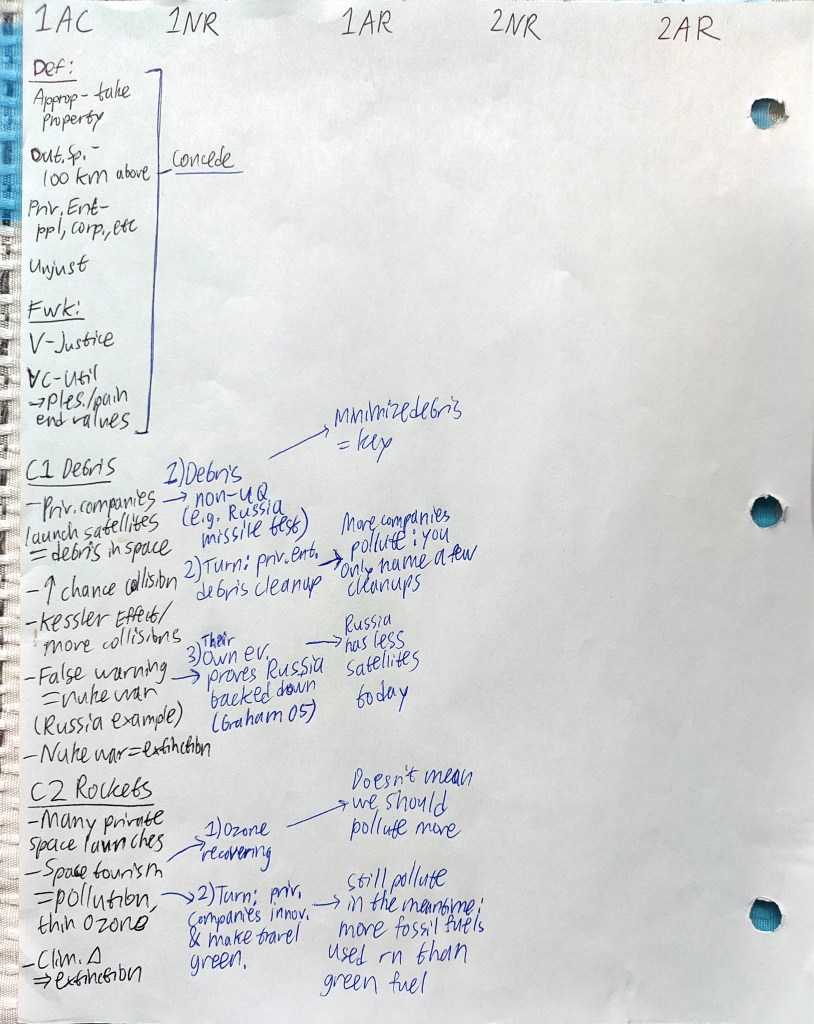
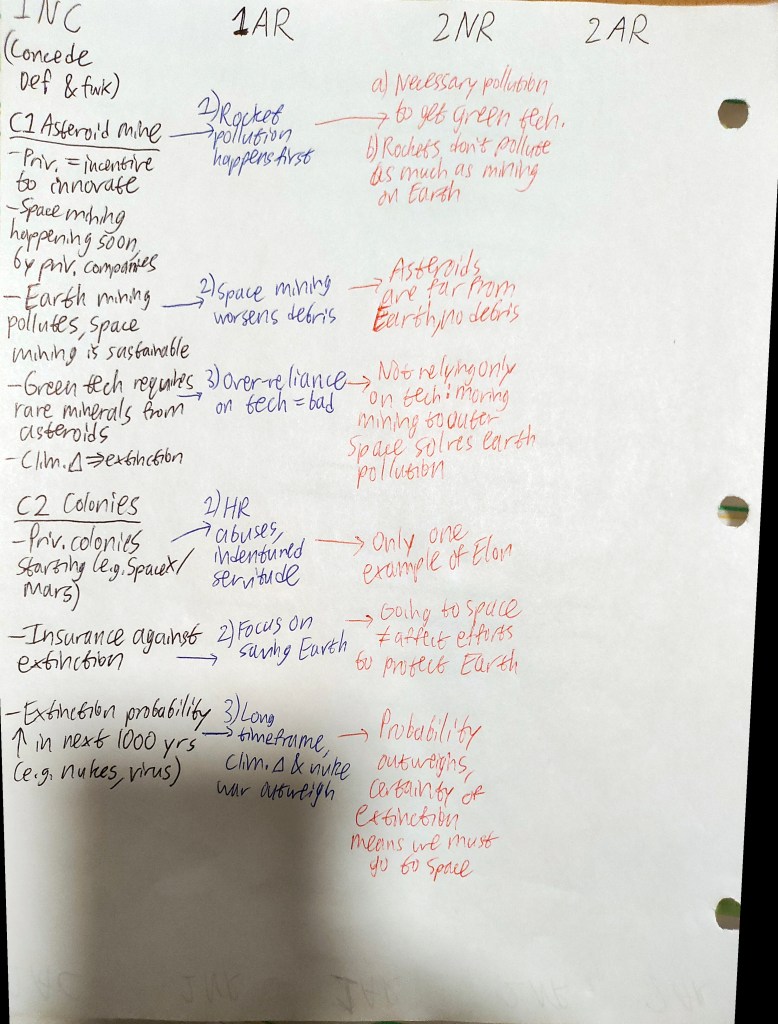
Neg 2NR
In red is all of the Neg’s 2NR.
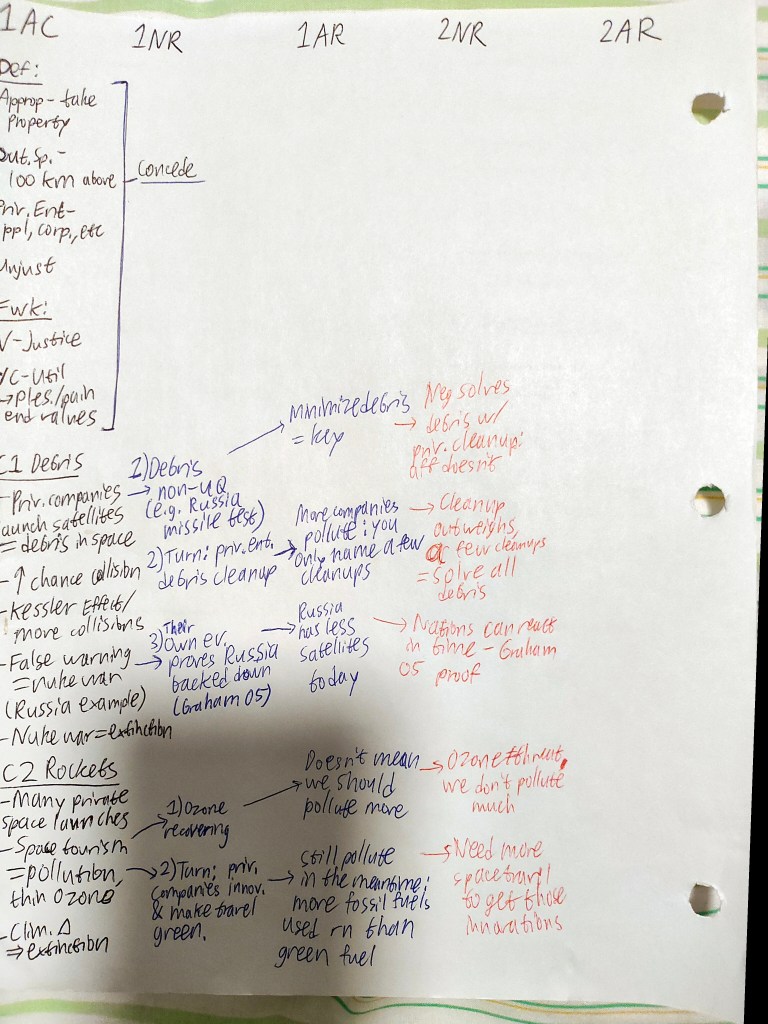
Aff 2AR
In blue is the Aff’s 2AR, in the last column of both pages.
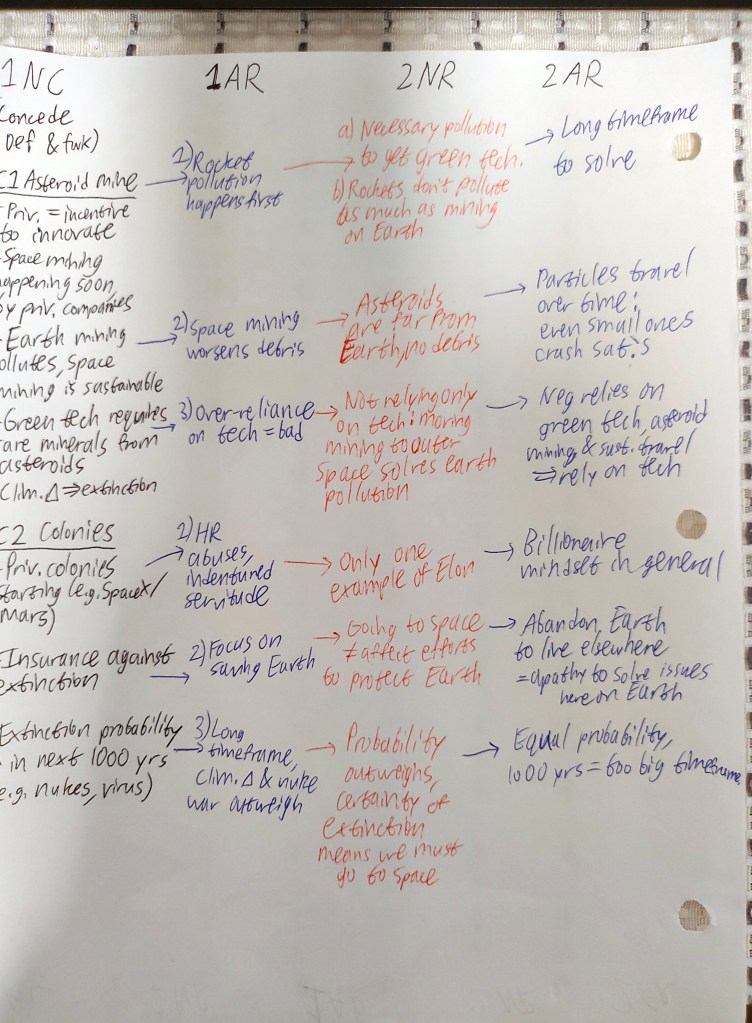
So there it is: flowing! By the end of the debate, your flow sheets should be filled up as shown above (after the 2AR). Don’t worry if it seems all confusing at first. It, again, takes quite a bit of practice to get flowing mastered to the point that you can effortlessly do it and also be able to generate rapid responses in the middle of the round.
Shorthand – Flowing Faster
Just like with jotting notes, writing down full sentences will slow you down in the middle of a round. Don’t write everything you or your opponent say word-for-word! Developing your own shorthand, in the form of simple symbols and abbreviations, is key to efficiency and doing well, but keep in mind that it takes practice and multiple tournaments to get the hang of it. Each debater’s favorite abbreviations are different, so take these following examples with a grain of salt and think of them more as inspiration in developing your own shorthand!
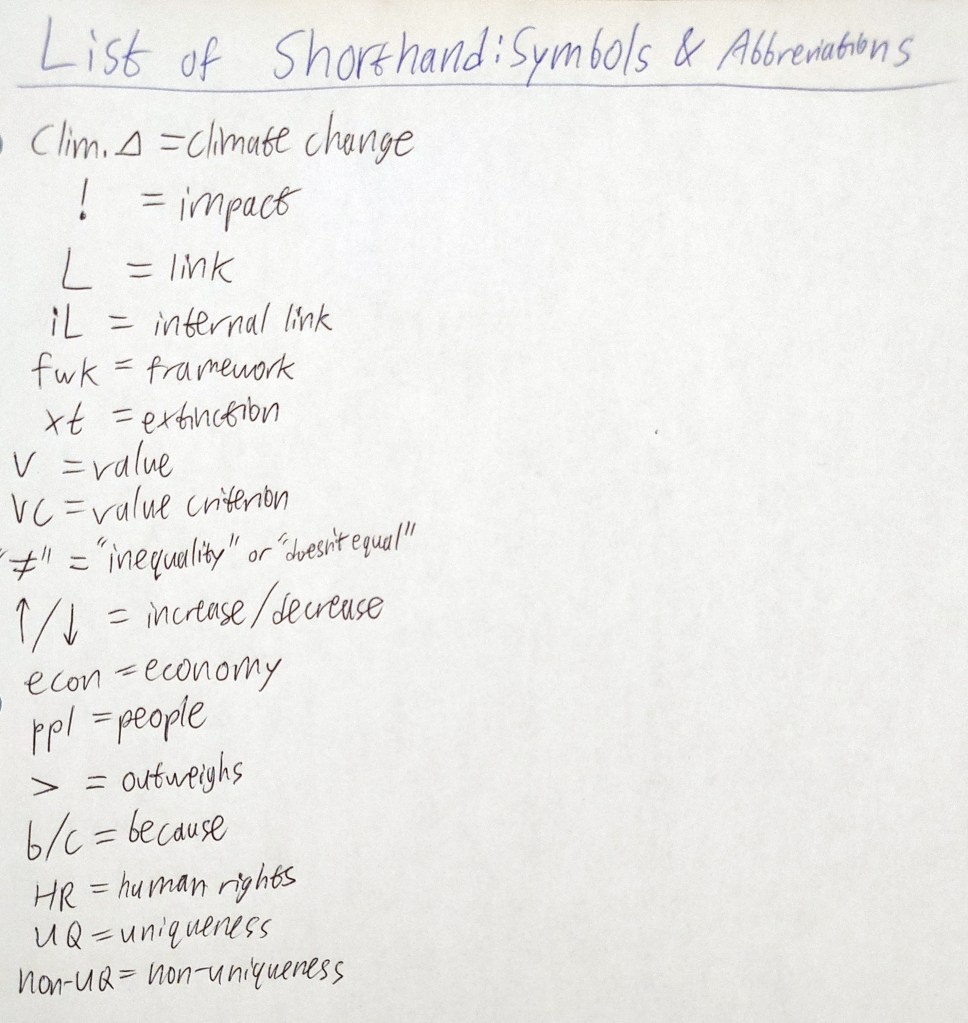

Now, you’re all set to furiously note-take in your debate rounds, write down some winning responses, and maybe sneak in a few stylish pen tricks in between! Be sure to keep your sheets of flow paper after every round, so that you may analyze and try to improve after every debate you have. Flows are especially important for redoing your rebuttals from the round (rebuttal redos), so that you may try to correct your mistakes from the actual round during practice. Basically, don’t throw your flow!

 LD Debate Prep