
This lesson will cover what the LD debate format looks like, specifically its speech times and speaking order, along with some examples of an LD round pictured in diagrams.
Every sport, game, or activity has a set structure, and LD is no different. With a certain amount of time designated for the round to take place, LD debate sets aside several speaking times and speeches for each debater, outlined below.
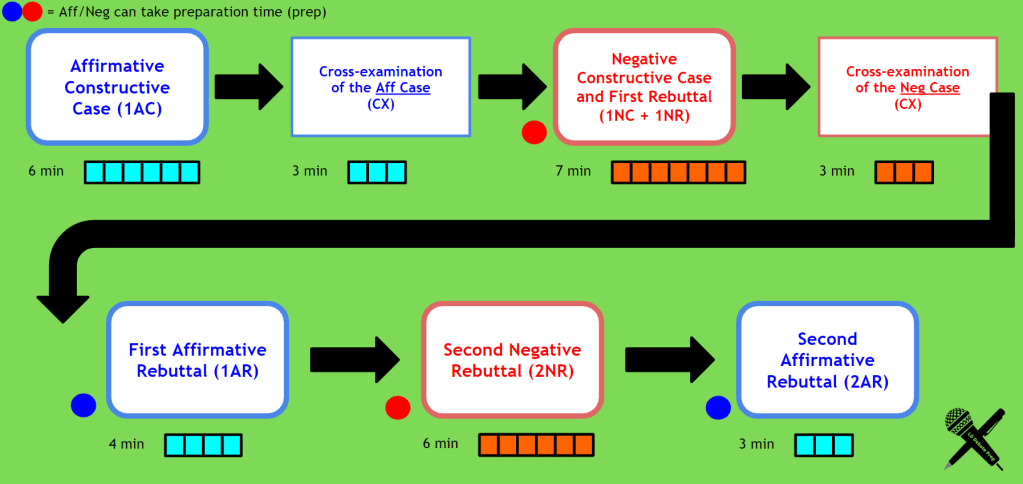
(larger version of the image at the very bottom of this page)
Don’t worry about studying these – feel free to bring a diagram of the speaking order into your first few debate rounds. Familiarity comes with practice across multiple tournaments!
| Speech Name and Abbreviation | Time (in minutes) | Detailed Description | Quick Summary |
| Affirmative Constructive Case (1AC) | 6 | The Aff will define the terms of the debate and attempt to frame the perspective that the judge should use for the round. Then, for the majority of the speech, they introduce 2-3 points or contentions that explain why their position is good and should be voted for. | – Aff introduces topic & definitions – Reads a framework – 2 to 3 reasons to Affirm the topic |
| Neg’s cross-examination of the Aff Case (CX) | 3 | The Neg asks the Aff questions of clarification if needed, while also attempting to poke holes in the Aff case. Think of this time as a Q&A involving (controlled and assertive) aggression combined with relentless interrogation. | – “Aggressive” Q&A – Neg asks Aff for clarification and/or tries to poke holes in their case |
| Prep Time for the Negative | 0-4 | The Neg may strategically take a few minutes of prep, or preparation time, before their constructive speech. They can take anywhere from none at all to 4 minutes, but no more (although keep in mind the Neg has another speech later on in the round, so it is wise to not use all of it right now). People usually use 2 minutes or less, organizing evidence and/or writing out answers to the Aff. Note: the Aff and Neg don’t share the same prep time clock (each has their own 4 minutes to use). But that doesn’t stop you from preparing while your opponent is calling prep time! | – Neg takes up to 4 min to prepare next speech – The room goes quiet… |
| Negative Constructive Case and First Rebuttal (1NC + 1NR) | 7 | Usually, the Neg takes 4 to 4.5 minutes to introduce their case. Then, they spend their remaining time (2.5-3 min) attacking the Aff case, which is called a Neg rebuttal. | – Neg may contest/disagree on Aff definitions – May contest framework – 2 to 3 reasons to Negate – Attack Aff case (rebuttal) |
| Aff’s cross-examination of the Neg Case (CX) | 3 | This time, the roles are switched: The Aff asks the Neg questions of clarification if needed, while also attempting to poke holes in the Neg case. | – “Aggressive” Q & A – Aff asks Neg for clarification and/or tries to poke holes in their case |
| Prep Time for the Affirmative | 0-4 | The Aff usually takes 2 minutes or slightly more, organizing evidence and/or writing out answers to the Neg. | – Aff takes up to 4 min to prepare next speech |
| First Affirmative Rebuttal (1AR) | 4 | Commonly known as the hardest speech to do (because of little time and being overwhelmed by the longer Neg speeches), the 1AR is the Aff’s turn to attack Neg arguments previously made. Aff must also rebuild their own arguments (called “extending“), while simultaneously answering Neg attacks made in the previous 1NC. If Aff doesn’t extend their own arguments, they effectively drop their own case (basically leaving no more reasons to Affirm), thus the judge will likely vote Neg in that case. Remember to extend! | – Repeat/summarize Aff points made in 1AC – Answer Neg attacks – Attack Neg points |
| Prep Time for the Negative | Remaining Prep Time (0-4) | The Neg usually takes their remaining amount of prep time (usually 2 minutes or more), organizing evidence and/or writing out answers to the Aff. | Neg takes remaining amount of time (from the 4 min) to prepare next speech |
| Second Negative Rebuttal (2NR) | 6 | This Neg speech does much of what the Aff rebuttal (1AR) accomplishes, except for the Neg debater: rebuilding the Neg, answering Affirmative attacks, and pressing on the Aff case with attacks – making the Aff’s next speech as hard as possible. Keep in mind that new responses introduced in the 2NR will usually be taken lightly by the judge due to the Aff’s next speech being shorter on time and the Neg already having time in the 1NC to address it (that is, unless the previous 1AR did something totally new). At the end of this 2NR speech, you could summarize the reasons to vote for you, a.k.a. listing “voters“, such as comparing the Aff and Neg cases (weighing). | – Repeat/summarize Neg points made in 1NC – Answer Aff attacks – Attack Aff points – Summarize reasons to vote for Neg (voters) |
| Prep Time for the Affirmative | Remaining Prep Time (0-4) | The Aff usually takes their remaining amount of prep time (usually 2 minutes or slightly less), organizing evidence and/or writing out answers to the Neg. | Aff takes remaining amount of time (from the 4 min) to prepare next speech |
| Second Affirmative Rebuttal (2AR) | 3 | Being the last speech of an LD debate round, this is the Aff’s chance to summarize the round in their favor (while doing last-minute attacking and defending, plus comparison between the sides). Remember that judges will take new responses in the 2AR with a grain of salt, due to Neg not being able to address 2AR claims afterward. Like the 2NR before it, the 2AR should use voters and weigh cases in order to summarize the main reasons why Aff wins the debate. | – Repeat/summarize Aff points made throughout the debate (carried over in 1AR) – Answer Neg attacks – Attack Neg points – Summarize reasons to vote for Aff (voters) |
Aff is in green, Neg is in red.
You may have noticed that the Affirmative (Aff) side has more speeches than the Negative (Neg), even having the last word of the debate, which helps to summarize the round from an Aff-biased perspective. This, although seemingly unfair, is balanced with the Neg’s two speeches, which are longer in time (thus easier to defend). This way, both debaters will have 13 minutes total to speak through their speeches (Aff = 6 + 4 + 3, while Neg = 7 + 6 minutes).


All of this adds up to around 40+ minutes worth of speeches and prep time each round. Realistically, you will also add in the 10-15 minutes of time the judge takes to make a decision and give their feedback to each debater, thus totaling up to 1 hour on average per round at a tournament.
Congratulations on your first glance at the LD debate speech order – this is a first step towards understanding and eventually mastering the activity as a whole!
 LD Debate Prep