
You might associate the word “debate” with the thought of a heated argument with classmates, parents, or siblings. Or you might think of the highly-anticipated national spectacle that happens every 4 years (the presidential debates). Neither of these are truly “debates,” at least not the serious academic competition type. Debating involves a clashing of ideas, where two sides may have a common problem to address or some common ground, albeit solving with different methods (not to be confused with a vicious exchange of personal attacks that you may see during verbal fights).

The argument above turned into a heated shouting match at times (unlike “Lincoln-Douglas” / “LD” debate at all, which is more of a civil conversation focusing on policies, philosophy, and real world stuff)!
Think of debates as structured and organized discussions, no matter the topic. This could look like a debate with a friend about whether having pancakes for lunch is good or not, cited with facts, evidence, and logic. The topic or central question here is whether having pancakes for lunch is good or not. For example, you want to defend this statement (agreeing or affirming that pancakes for lunch are amazing!), while your friend dully disagrees (negating it instead). Now the topic, or resolution, could be worded as Resolved: Eating pancakes for lunch is good. Your burden as the Affirmative side (Aff) is to prove that the resolution is good or true (that pancake lunches are fantastic), and therefore should be voted for by the judge. The burden of the Negative side (Neg) is to persuade the judge to not vote for the Aff and vote Neg instead (booo pancakes for lunch). Both sides have a burden of clash: they must present counterarguments related to what their opponents have presented, rather than making speeches that stand alone or are unrelated to the core conflict of the debate. Not engaging with an opponent’s points enough or leaving key opposing arguments unaddressed can foreclose any chance of winning (but don’t worry, it takes time to learn and get used to)! It is crucial to point out and attack weak points in your opponent’s arguments, or else your opponent will likely win due to having their arguments go unchallenged or uncontested. Thus, debate is a clash of different and diverse positions.

Putting aside the hypothetical topic about pancakes, examples of real debate resolutions across the years include:
- “Resolved: when they are in conflict, a business’ responsibility to itself ought to be valued above its responsibility to society” (November-December 1996).
- “Resolved: States ought not possess nuclear weapons” (September-October 2010).
- “Resolved: Developing countries should prioritize environmental protection over resource extraction when the two are in conflict” (January-February 2014).
- “Resolved: The United States ought to guarantee universal child care” (March-April 2021).
- “Resolved: In a democracy, a people ought to have the right to secede from their government” (National tournament 2024).
As you might notice, debate topics aren’t afraid to dig into the weeds of current politics and controversial discussions. Additionally, debaters can expect to prepare both sides of each topic, which helps challenge our existing ideas and worldviews.
There are many different events or types of high school and college debate, but the undisputed and objectively best one is the Lincoln-Douglas (LD) type of debate – the one that LD Debate Prep will thoroughly cover and teach here! Typically, in speech and debate (including in LD debate), there is one other person or adult in the room (called a judge) who decides the winner between you and your opponent(s). LD is uniquely distinguishable from other events for its 1 vs 1 format, the inclusion of philosophical discussions in the round, and the fact that the topic changes fairly frequently (every 2 months).
Meanwhile, examples of other debate events popular in the United States (offered under by the NSDA – National Speech and Debate Association) include Public Forum (PF), Congress, Policy, World Schools, and Big Questions (BQ) debate. Other styles, such as British Parliament (BP) and Canadian style (CNDF), are used elsewhere. Additionally, every school’s speech and debate club is incomplete without various speech events, emphasizing participants’ presentation and oration skills over their debating or clashing abilities (these speech events are completely different from delivering particular speeches in debate rounds). Some different types of speech include Impromptu, Original Oratory, Extemporaneous, Dramatic Interpretation, and much more.
“Why should I do Lincoln-Douglas debate specifically when there are so many debate and speech events?” To that, I would suggest to think about how thrilling it would be to fluster and destroy an adversary, face to face and one on one, by overwhelming them with concrete facts or spitting out irrefutable evidence. On the other hand, as a receiver of a one-sided beating, think about how this experience would fuel motivation to improve and train intensively, hoping to one day avenge a loss and reclaim glory. Armed with evidence and logic, you’ll debate to your heart’s content and directly confront an opponent in-round, in contrast to the more rhetorical approach of speech. Though speech events are great in their own way, debate truly gets one’s mind running, gears turning, and competitive spirit going.
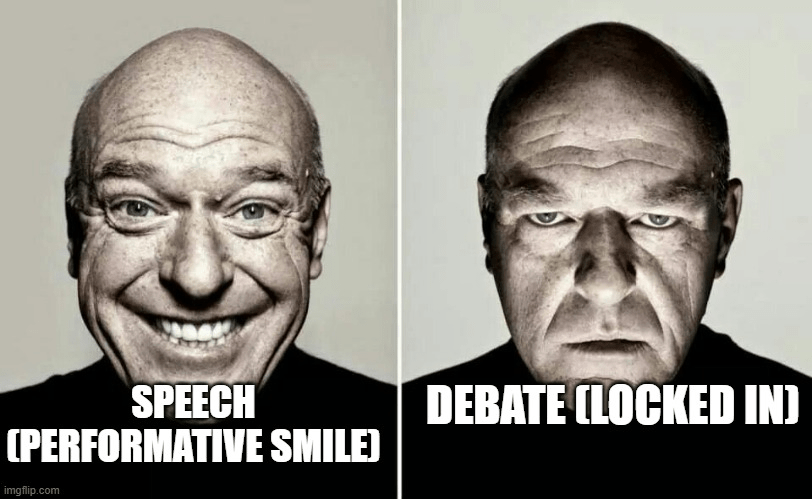
This will be the last of the commentary on speech events 😔
Contrary to the memes and stereotypes, LD debate isn’t about researching in a dark basement by yourself, sunlight-starved for days on end – of course not! It’s a lively and collaborative process! Speech and debaters love helping each other out, which makes solo events feel all the less intimidating. School teams, fellow competitors, mentors, judges, coaches, former debaters, etc – anyone you can get ahold of either in-person or online. Additionally, standing out from other debate events, LD brings out the best habits and practices from within us. By working solo, rather than with a partner, an LD debater becomes accountable only to themself. Their actions moving forward would be built upon self-direction rather than being tied to a partner. Responsibility is generated by themselves. Having a partner to carry you may not be the most educational experience, while in the other extreme, you carrying a partner can be quite the tiring process. Though going solo sounds scary at first; the LD community, LD Debate Prep, and your own sheer strength have got you covered!
This was my totally facts-based and unbiased rant about why LD is the best. Speech and debate in general is worth giving a shot. All events are fun to compete in and everyone from this community is phenomenal in their own way! But one event still stands above the rest. And if anyone else says otherwise, they should 1v1 against a Lincoln-Douglas debater right now (in LD, please not in real life)…

JoJo’s Bizarre Adventure
 LD Debate Prep